Where Function Meets Form
A lifelong interest in art and visual thinking, channeled through technology, usability, and the belief that how something works should be inseparable from how it looks.
Origin Story
The interest was always there. As a kid, Andrew was drawn to drawing, building, and making things look a certain way. The kind of attention to aesthetics that shows up early and doesn't really leave, even when life pulls you toward other things.
For a while the art paused. School, career, the usual trajectory. But the eye for design never fully went away. It just found new outlets.
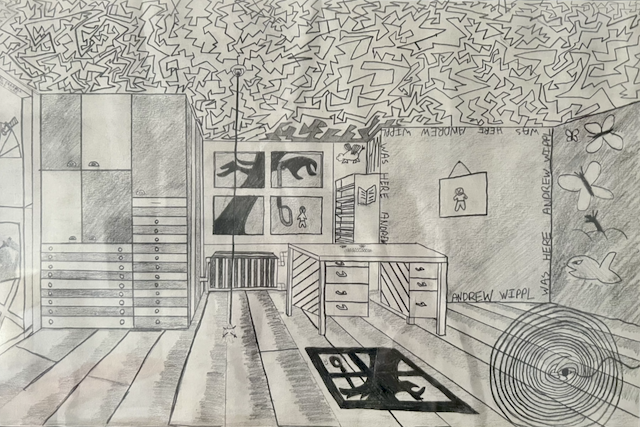
Early artwork — photos coming soon
University of Virginia
At UVA, computer science lived in two places: the College of Arts and Sciences and the School of Engineering. Same core curriculum. Same algorithms, data structures, systems courses. But the paths diverged after that.
Andrew frames it as the Apple vs. Microsoft split, even if UVA didn't see it that way. Engineering students filled their remaining credits with practicum and technical electives. College students had room to explore.
Andrew loaded up on media studies and design courses. Typography. Visual communication. Human-computer interaction. The technical foundation was identical, but the periphery shaped a fundamentally different way of thinking about software: not just what it does, but how it feels.
Direct Influence
Andrew sits on the AWS Customer Council, providing direct usability feedback on AWS products. Not theoretical feedback. The kind that comes from working across 50+ application implementations and knowing exactly where the friction lives.
He's given feedback and watched it show up in the product. The same pattern repeats with other vendors: detailed, experience-driven input that gets adopted because it comes from someone who actually uses the tools at scale.
50
App Implementations
AWS
Customer Council
Direct
Product Influence
Rethinking Security UX
Trust centers are how organizations demonstrate their security posture to prospects and clients during procurement. In practice, this means responding to security questionnaires — detailed reviews that assess an organization's compliance, controls, and risk management. A client sent a 20-question security review one year. The next year, the same client sent a 200-question review. That's a 10x increase in compliance work, and with the variety of applications and technology stacks involved, AI has not been effective at generating accurate responses.
When Andrew evaluated trust center products from GRC (Governance, Risk, and Compliance) vendors — platforms designed to centralize security documentation, risk assessments, and audit workflows — the quotes came back extremely high and the implementations didn't reflect how organizations actually handle these processes. The tools were built for compliance teams, not for the sales teams who are on the front line of the procurement process.
So he started building differently. His approach embeds trust centers into the sales process the way CLM (Contract Lifecycle Management) software does — giving sales teams the ability to operate independently while still being informed of where the compliance and security functions stand for their prospects during due diligence. Sales doesn't need to wait on security to know the status of a review. Security doesn't need to chase sales for context.
There are currently separate themes for Privacy and Security, with Legal coming next. Once the theming is finalized, the application will be built out with full CLM functionality — tracking contracts, reviews, and compliance artifacts through their entire lifecycle from initial prospect inquiry to signed agreement.
10x
Compliance volume increase
Sales
Independent visibility
3 Themes
Security · Privacy · Legal
CLM
Contract lifecycle model
HubSpot Expertise
WippSpots — a play on Wippl and HubSpot — is the product of years of HubSpot design and implementation work, taken far enough to build a standalone offering. The site has been built out, and Andrew is currently working on the final phases of the themes that will define how organizations present their security, privacy, and compliance posture to prospects.
It combines deep platform expertise with a design sensibility that most HubSpot implementations lack — because most implementations aren't built by someone who thinks about both the security architecture and the user experience at the same time.
